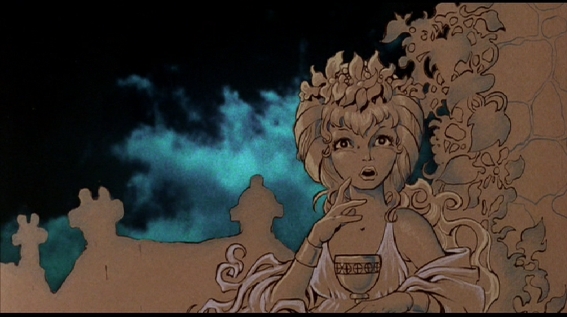
Figure 1: Delia, a good fairy, expresses surprise. (© 1977 Bakshi Productions)
The IMDB page for Wizards is here.
Ralph Bakshi's Wizards (1977) appears on virtually no lists of the greatest films ever made; the film itself is available on DVD only due to its status as a "cult classic." Wizards tells the story of a post-nuclear Earth, millions of years in the future, wherein all living beings are hideously (and sometimes hilariously) deformed. Those who are left believe either in magic (the good ones) or in technology (the bad guys). From the rubble in a land called Scortch, two leaders emerge: Avatar, the good wizard, and his evil twin, Blackwolf. They spend the majority of the film battling each other.
The hipsters who enjoy Wizards seem to do so only as a function of ironic consumption, cheerfully watching the primitive animation and ludicrous story about a post-apocalyptic, mutated world populated by wizards, magical animals, and women with suspiciously large breasts. However, there is more to the film than the hipsters may realize: it employs sophisticated instances of what Sergei Eisenstein called "overtonal montage." This use of overtonal montage makes Wizards less of an animated B-movie "for grownups" and more of a film that has a real opinion about the world in which it was made, specifically, with opinions about the technology in this world. When examining its form, a paradox is revealed: it is a film that is staunchly anti-technological, yet were it not for technology, this statement would be impossible to make. As the film's theme largely hinges on the dichotomy of magic versus technology1, this stylistic interplay is curious. In order to prove this, I will discuss one specific montage sequence in the film, and the continual use of filmed events, such as smoke, fire, and water, within the same frame as the animated footage.
Beginning early in the film, Bakshi employs montage in an innovative way, creating a collage of different images within the same frame. The background employs shots of smoke, fire, or water that are tinted and colored to suit the mood of the shot. In contrast, the foreground remains animated. The elements within these shots co-exist separately, never overtly acknowledging the other's presence. The animated characters do not interact with the smoke2 and the smoke does not do anything such as engulf them. Occasionally characters in the story acknowledge what the smoke or background images are supposed to represent, but their eyelines never directly match the background. One can often assume that what is in the background is also meant to be in front of them and otherwise off-camera.
This use of mixed medium seems to indicate an affinity for what could be called "micro-montage." Bakshi projects a filmed background of sinister smoke behind a hand-drawn (animated or still) foreground, and uses this technique several times throughout Wizards. The two different methods are intermixed in the same shot. The movement of the animation itself is displaced by and contrasted with the smoke's movement. The strength of these shots comes not from the individual components, but from the relationships between the images.
Figure 1: Delia, a good fairy, expresses surprise. (© 1977 Bakshi Productions)
The smoke provides a mood-setting backdrop; the foreground and audio track provide narrative information. They are undivided by a frame and juxtaposed not side by side but integrated into a larger whole. That is, there are no linear breaks within the frame to differentiate the filmed footage from the animated, although it is painfully obvious which is which. This whole is constructed of parts whose individual impact has been assessed: the smoke for its spooky mood-setting capacity, the animation (or still) for its continuity of the narrative. The strength comes not from each individual piece, but from the "collective calculation" of the parts working together as a whole. This collision of techniques paves the way for what Eisenstein would call "real cinematography." The different components within the frame echo and amplify each other, creating a hybrid that is more than the sum of its parts.
Finally, more conflict is created within the image: dissonance mounts when one notices the disparity between the component images: the animation portrays unrealistic depictions of humanoid bodies, supposedly so changed due to the negative impact of technology (nuclear radiation); the filmed components generally show smoke, fire, or water. These natural events are portrayed mimetically and realistically with the exception of the tint in the frame. The juxtaposition within the same frame is a distancing technique in that it announces to the viewer that both of the representations cannot be real, even though they work together in a fashion that is intended to be seamless.
Eisenstein writes that "[overtonal montage] is distinguishable from tonal montage by the collective calculation of the piece's appeals….Within a scheme of mutual relations, echoing and conflicting with one another, they move to a more and more strongly defined type of montage, each one organically growing from the other."3 This is an interesting conflation of the definition of overtonal montage, as it challenges the definition on the level of the frame. Bakshi's work could be compelling evidence for the creation of cinematic rhythm and conflict within not just the same shot, but the same frame. Eisenstein wrote, "Real cinematography begins only with the collision of various cinematic modifications of movement and vibration."4 These sequences demonstrate a genuine collision of cinematic modifications because of the variety of animation techniques they convey. Assessing the collective impact of each piece, something greater is achieved. This inter-frame montage also works with the shots around it, creating ever higher levels of conflict and montage.
However, the film makes its boldest moves during the montage sequence in which Blackwolf, the evil wizard, previews his super-evil weapon to his minions. The secret weapon, the "key to creating hysteria," is film itself – but not just any film; he shows his minions archival footage of Nazis. Bakshi cuts between shots of Blackwolf, his followers, the video camera, and the screen displaying the archival footage before the archival footage becomes diegetic. That is, it takes up the entire frame and the spectator no longer has orienting animated information to ground him or her within Bakshi's diegesis. The spectator is put into the place of the followers, and the spectator's eyeline becomes aligned with that of the villains.
Eisenstein writes, "Overtonal montage [grows] from the conflict between the principal tone of the piece (its dominant) and its overtone."5 Heretofore, the film has been a fairly innocuous, slightly silly and nearly impenetrable animated tale that is clearly targeted at the asocial, oversexed adolescent male demographic. The introduction of the World War II archival footage, however, lifts the film up into another realm. At one point within the sequence, the frame shows three separate elements simultaneously: archival footage, the treated smoke shots, and the hand-drawn animation that is the core of the film.
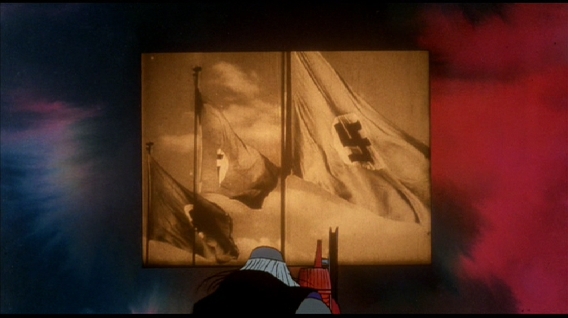
Figure 2: Blackwolf, the villain, harnesses the secret, evil power of film to whip his followers into a homicidal frenzy. Note hand-drawn foreground contrasted with the archival footage and the filmed background. (© 1977 Bakshi Productions)
By creating conflict between the tone of the cartoon and the overtone created by this archival use, the film becomes much more powerful. The archival footage serves as a reminder that despite the mutations, amateurish drawings, and primitive animation, the film is meant to take place on the same planet that we inhabit; the characters are meant to be our descendents. The world within the film is supposed to be our world, rather than a world.6 The characters of Wizards share history with the intended spectator.
Within the context of the film's themes of magic / faith versus technology, this use of "found footage"7 seems to be a very interesting comment on the power of film: cinema's power is used here to enthuse people about war. The sequence employs several shots of the camera that Blackwolf uses to show the film to his minions. Within the montage, these shots last for a privileged amount of time, as Blackwolf forces his tiny fairy prisoners to work as post-apocalyptic projectionists. The shots of the projector open the sequence, and these shots are among the most innovative in the film: the projector projects directly into the camera, and then the camera zooms in onto the projector. Further, the shots of the projector frame the sequence, beginning with Blackwolf's rally and ending with the Scortch-ians beginning their battle against Elfland. This again distances the viewer, drawing his attention to the medium and forcing him to question the reality of what he is watching.
In a film with little sophisticated camera movement, it seems both deliberate and self-referential that the camera should move in such a way when it is depicting a literal camera. This synergistic feedback circle is a comment on film itself. On a deeper level, it seems to be a comment on technology – including the technology that made this film possible. It is the film of Hitler and his followers that later causes the elves to flee in terror and lose the battle. As the elves are aligned with the Good side of the Good/Bad dichotomy within the film, Bakshi seems to be commenting on the nefarious use of technology to defeat good. It is very telling that in the post-apocalytpic world of the film, it is not nuclear bombs or hyper-advanced guns that nearly fells the "good" race, but rather, simple film reels inflicted on an unwilling audience. The film provokes the necessary reactions from both sides: strength for Blackwolf's followers, and terror in the elves.
The fact that the Nazi footage is what whips Blackwolf's spectators into a frenzy is worth mentioning: the swastika on which he hangs out does not have this power, nor do any of his weapons or magic tricks. His followers do not have superior weapons. They gain their ability to make progress in the war due to their reaction to the film. It is the film that incites them to action, and this sequence is constructed in a montage sequence. As Blackwolf puts it, film is "The key to creating hysteria – fear!"
What, then, is Ralph Bakshi suggesting about technology? The main message of the film seems to be that technology is evil, capable of turning blind followers into dangerous ones. Meanwhile, magic and nature are privileged as the main ways of ethically interacting with the world. The montage sequence of Blackwolf's rally certainly suggests that Bakshi feels ambivalently about film itself. Could Blackwolf be a stand-in for the figure of the director? Bakshi's message about technology is made possible through both technological advances (different kinds of filming) and philosophical ones (Eisenstein's theories for the methods of montage). It is paradoxical that these messages are only made possible via the very thing to which they stand in opposition (somewhat like Marxists traditionally coming from bourgeois backgrounds). Could the film really be a meditation about how one can examine hegemony without establishing a system of production inside of it? From this perspective, there is certainly more to Wizards than most would acknowledge.
1 Such conflict can be seen as standing in for faith versus science.
2 Ralph Bakshi states in the director's commentary that this smoke is actually dry ice.
3 Eisenstein, Sergei. Film Form. San Diego, 1949: Harvest Books. Ed. And Trans. By Jay Leyda. Pp. 78, 79.
4 Ibid, 79.
5 Eisenstein 79.
6 See Nichols, Bill, Representing Reality.
7 This is meant quite literally as within the narrative, Blackwolf has his minions dig in the ruins of the Earth until they find the reels.
Writing CANNOT be reproduced without permission. E-mail me for reproduction information.